The Quaker Parrot (Monk Parakeet) may be the best Parrot.


THE Quaker's speaking ability is considered by many, to be in the Top Ten of Speaking Birds. Many of the more popular Parrots, don't have much of a personality. They may speak a bit clearer, with a few more phrases, but personality? Not so much!
This little guy will keep you on your toes.................... What's that your eating? I want some!.....Where you goin'? Take me with you!!!!! I Love to sing!! Teach me a song. The Nest Building is Unique to the Quaker Parrot (monk Parakeet). Give him some materials, and watch him go!
Don't let your Shepard, or Siameese around!!! They'll be chased down the hall, by this little bundle of feathers.


The Quaker's speaking ability is astounding!


SMOOCHES' cage cover is an orange towel. He knows it as "My Baby". Time appropriate, he says, "You got my Baby", "Here's your Baby", "We go Beddie-Bie". It's now time for "Peek-a-boo".
The "Time Appropriate Speech" is rare to any "Mimicking Birds" While the Quaker does mimic many sounds , there are many things you may hear from the Quaker, You won't hear from most other Parrots.
While your washing your hands, or maybe some Vegies, "Whatcha doin'". Maybe if you leave the room, "Where ya goin'", "I Love You", "I miss You", or maybe just a "big wet kiss". We can't forget "Come 'ere"!!!!
The Quaker Parrot is definitely a "HUGE PARROT, in a TINY BODY"
If your thinking about placing a bird into your home, don't overlook "The Quaker Parrot"!


I'm looking for:


Wednesday, February 24, 2010

Blue Quaker Parrots


The Blue Quaker


The blue Quaker was first noticed in the wild, in Belgium, in the 1950's. A well known Bird Keeper ,and breeder in England, The Duke of Bedford, had several pairs caught for him. It's believed that all blues, come from this stock.

Through the mid to late 1900's several pairs of Blue Quakers were imported to the U.S., to a couple of breeders. These breeders started selling their offspring to other breeders. This is where the abundance of Blue Quakers, in the U.S., comes from.


What Makes A Quaker Parrot Blue?

Lets discuss color for a moment. "White Light" has all colors that Human eyes can distinguish. When we see an object that appears red, what is really happening is, that object is absorbing the other colors of "White Light", and only allowing us to see the red.

Generally, we see a Quaker Parrot as green. The Quaker Parrot has a pigment gene that makes the feathers appear yellow. At the same time, a different gene gives the feathers structure. The structure of the feather has a kind of prism effect, reflecting light to appear blue. The combination of blue light, and yellow feathers, makes the Quaker appear green.

When the pigment gene is less prevalent, the blue shows more dominantly. When the structure gene is less prevalent, the yellow shows more dominantly.When both are minimally present, we have a Pallid. With both absent, we have an Albino.


This is basically were Blue Quakers, and Yellow Quakers come from. You can find more scientific data by searching something like, "avian genetics".

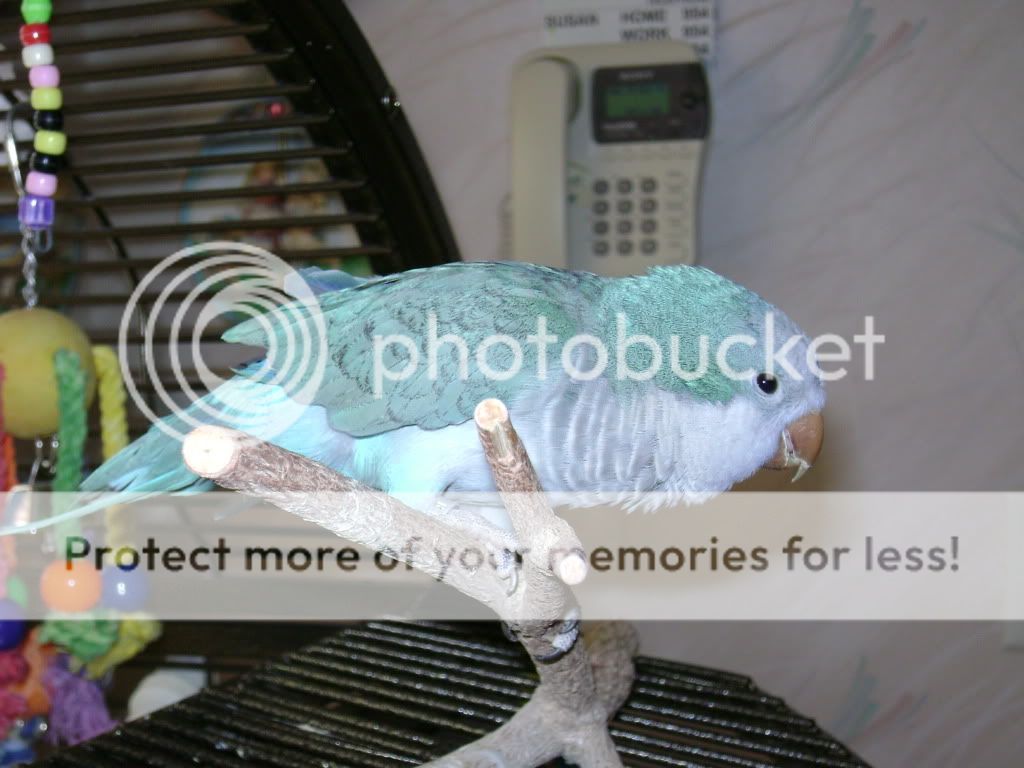
Take a close look at SMOOCHES' feathers. (Photo above^) He is not a Pearl, but notice how the shades of blue seem to change through out the feathers. This is very similar to what a pearl, of any color, might look like. With a Pearl, the varying shades are much more prevalent.

Some of the other varieties include Cinnamon, Pied, and Lutino

jaytee


I'm looking for:


PetSmart - Bird

SMOOCHES


"SMOOCHES" THE BLUE QUAKER


Almost a year ago, I bought my girlfriend a QUAKER PARROT. She's had "BIRDS"
before, so I knew she could handle it. I, on the other hand had no idea
what to expect. I'm totally amazed by, what this little bundle of
feathers, is capable of.


I'd like you to meet "SMOOCHES".

Smooches is a BLUE QUAKER.

About 2 1/2 years ago, "K" went to the pet store, for turtle food. She told me she saw a "beautiful BLUE QUAKER", and wanted to bring him home that day. Over the next couple of weeks, I kept hearing, "I went back..... he's still there....... he's so
beautiful....". Then one day, she said "he's gone! Someone bought him!"

I was on a "mission".

Gotta find a "BLUE" for my baby.

Finally, after over two years of searching, I was told, "we have two BLUE QUAKERS coming in today". FEB. 13, PERFECT!!!!!!!!! I kept wondering, ....how do I decide between the two?.......... While filling out the paper work, "ONE" was delivered. I guess the choice was made!!!!


We spent the next several weeks, visiting this tiny little bundle of joy, as much as possible. Finally!!!!!!!!!!!!!! Time to come home!!! Then came the bad news!!! "AS MUCH AS YOU WANT TO HOLD HIM, AND CUDDLE HIM, YOU NEED TO AVOID CONTACT, AS MUCH AS POSSIBLE, FOR TWO DAYS". (Birds need to get accustomed to their environment). Hard as it was, we did as instructed.

During the first evening, and following day, he did quite a bit of SCREECHING. When he did, we (usually, simultaneously), would say what!!!! Within about 22 hrs. of being brought home, he said his first word. "WHAT!!!!!!". Since then , it's been a roller coaster ride.

The words/phrases he's learned to say, the sounds he mimics, are astounding!!!!!!! "COME 'ERE", "WATCHA DOIN'", "I'M A VERY GOOD BOY",just a small example. The sound of, "CHUGGING WATER FROM A BOTTLE", "WOLF WHISTLE", "THE SOUND OF A REALLY WET KISS". On top of all that, "24", I repeat, "24" "BIRD CALLS HE LEARNED FROM 2 (COO- COO CLOCKS)!!!!!!!!!!!

When the "GODS" made the decision for me, on which of the two, they must have known what they were doing!!!!

I don't think you can hope for, such a great outcome , in such a short time. But if your looking for a "great talker, for a reasonable price", the QUAKER is the way to go!!!!!!!!!!

jaytee


I'm looking for:


PetSmart - Wild Bird

Monk Parakeet (Quaker Parrot)


About The MONK PARAKEET......


Facts and Info

MONK PARAKEET....Myiopsitta monachus

The “MONK PARAKEET”, also known as QUAKER PARROT, or QUAKER PARAKEET,
originates from South America. Specifically, ARGENTINA, BRAZIL, PARAGUAY, and URUGUAY.


The "QUAKER" parrot was transported to the US, and parts of EUROPE, through the '70's, '80's, and less in the '90's, to present. Wild "MONKS" through-out the AMERICAS, and EUROPE, it is believed, are due to "shipments being lost, and or opened", "the release of unwanted pets", or the "escape of pets".

Wild QUAKERS In The STATES


The "FERAL" MONKS can generally be found in low-lying areas, around cities, or suburbs. (MONKS seem to love being near HUMANS, not likely to be found out in the wild). Monk Parakeets generally make their homes in trees, although, it's not uncommon to find them nesting in utility poles. For this , and other reasons, they have been banned from some STATES.

Parakeets, budgies, and a few others are all of the Parrot family. Because of it’s size and long tail, the Monk is generally referred to as, a Parakeet. Monk Parrots are known for their ability to mimic sounds, and human speech. While the Monk’s speech, may not be as clear as the "AFRICAN GREY", or some of the "AMAZONS", the Monk is considered to be in "THE TOP TEN SPEAKING BIRDS".

The MONK is mostly green. The forehead, chin, breast, and belly, have varying shades of gray to blue-gray.The flight feathers, and the underside of the tail, are usually a deep blue. The under-belly,thighs, and sometimes upper-inner-shoulders are a pale yellow-green.The beak is yellowish-brown. The legs are gray, and the iris is dark brown.

The name “MONK”, may have come from their resemblance to a Monk Priest with his long white beard, and his hood pulled over his head. The name “QUAKER”, Many think, comes from the young chick’s occasional, uncontrollable shaking, or “Quaking”.

The MONK is a fun loving, energetic creature. MONKS love their toys, swings, bells, etc.


MONKS need to be kept occupied. Spend as much time with your MONK as you can!! Placing his cage where the family is, most often, will help to make him a more social family member.

The Monk requires constant stimulus. Moving toys, and exchanging toys will keep him on his toes.


He will destroy his toys. The ones most destroyed, are probably favorites. Replace
those with similar, but not the same. These minor changes will keep the brain, and body active. Spend time with your MONK. The more time you spend playing, and talking, the more he will want to spend with you, playing , and talking. While the MONK is a very "socialistic creature",
in nature, it can be very "anti-socialistic" in captivity. The MONK can take over the “ROOST”. "DON'T REACH INTO MY CAGE!!!", "DON'T TOUCH MY TOYS", "DON'T TOUCH MY FOOD/WATER", etc............. His cage is his “HOME”. He will defend it at “ALL COSTS”.

This little guy can “TAKE OVER YOUR LIFE", if you let him. On the other hand, this
little bundle of feathers can bring such joy into your life........ Middle of the day, when he thinks he‘s alone, he'll start saying everything he knows to say............jabber, jabber. It's a real riot, sometimes hysterical. Talking, singing, whistling........Just hide around the corner. It’s possible you’ll here him say something, you never heard him say before!!! The more time and love you
spend with your new companion, the more time and love he will give to you!!!

Did I mention adopt? Many Parrots grow to a very old age, and lose their companions. Please consider adoption!!!!

jaytee


I'm looking for:


PetSmart - Bird

Parrot Pics/Photos

QUAKER PARROT Pictures, Original. Miami-Dade County, Broward County, South-East Fl.


These are photos I captured near home, and near work. Broward County, and Miami- Dade-County Fl.


In this collection of Quaker-Monk pictures, you'll find pics of Quaker condos, pictures of Quaker Parrots bathing, even some photos of wild Nanday Conures. Oh, and don't forget the pictures of a Blue Quaker (SMOOCHES),bathing.


Shop Petsmart
Shop pet mountain Pet Supplies

There's still more info!!

PREVIOUS PAGE

NEXT PAGE

jaytee